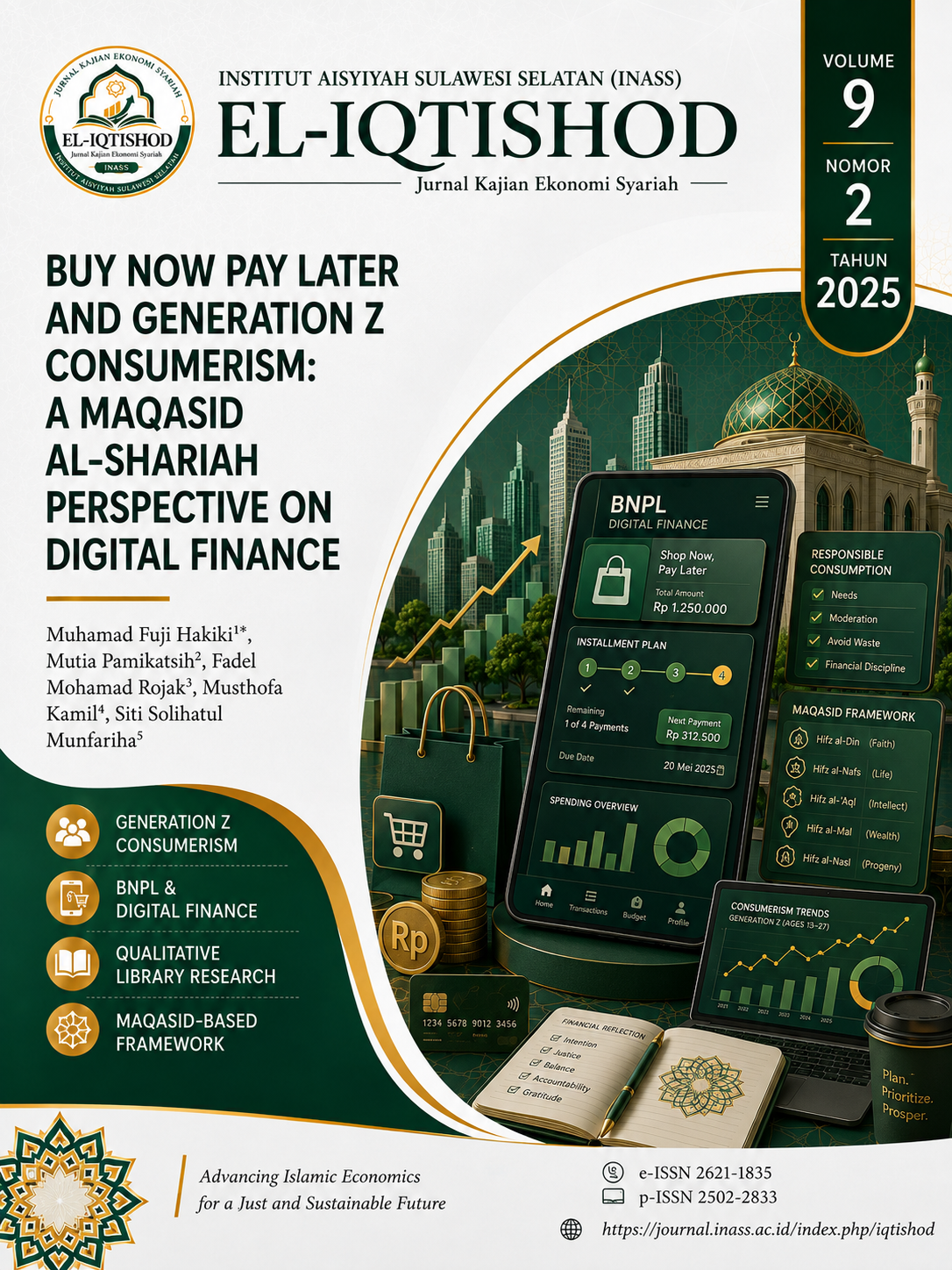
Buy Now Pay Later and Generation Z Consumerism: A Maqasid al-Shariah Perspective on Digital Finance
DOI:
https://doi.org/10.70136/el-iqtishod.v9i2.663Kata Kunci:
Buy Now Pay Later, Generation Z, Maqasid al-Shariah, Digital Finance, Consumer BehaviorAbstrak
The rapid growth of Buy Now Pay Later (BNPL) services has transformed consumer financial behavior, particularly among Generation Z, one of the most active groups in the digital economy. While BNPL offers greater payment flexibility and improved access to digital financial services, concerns have emerged regarding its potential to encourage impulsive spending, excessive consumption, and financial vulnerability. Existing studies mainly focus on financial, behavioral, and regulatory aspects of BNPL, with limited attention to its implications from an Islamic economic perspective. This study aims to analyze BNPL usage among Generation Z through the lens of Maqasid al-Shariah. Using a qualitative library research approach, the study examines relevant literature from books, scientific journals, research reports, and academic publications related to BNPL, consumer behavior, digital finance, and Islamic economics. The findings indicate that BNPL functions as a double-edged financial innovation. On the one hand, it promotes financial inclusion, purchasing flexibility, and participation in the digital economy. On the other hand, excessive reliance on BNPL may contribute to consumerism, debt accumulation, and weakened financial discipline. From the perspective of Maqasid al-Shariah, particularly hifz al-mal (protection of wealth) and hifz al-'aql (protection of intellect), BNPL should be assessed based on its contribution to responsible consumption and financial well-being. This study proposes a Maqasid-Based Framework for Responsible Digital Consumption consisting of financial awareness, spending necessity, debt responsibility, wealth protection, and ethical digital consumption. The findings contribute to the development of Islamic economic discourse on digital finance and responsible consumer behavior.
Unduhan
Diterbitkan
Cara Mengutip
Terbitan
Bagian
Lisensi
Hak Cipta (c) 2026 Muhamad Hakiki, Mutia Pamikatsih, Fadel Mohamad Rojak, Musthofa Kamil, Siti Solihatul Munfariha

Artikel ini berlisensi Creative Commons Attribution 4.0 International License.