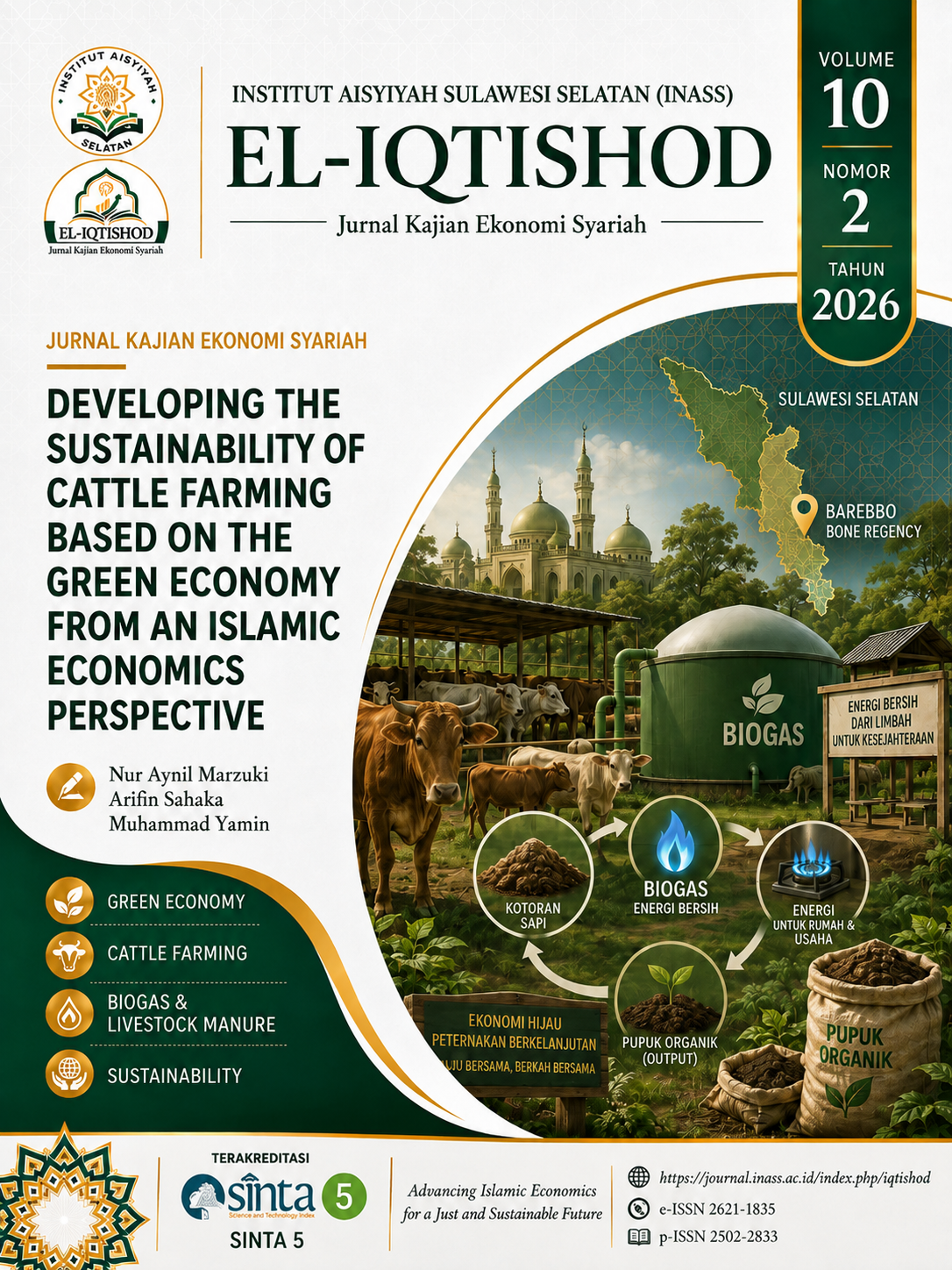
DEVELOPING THE SUSTAINABILITY OF CATTLE FARMING BASED ON THE GREEN ECONOMY FROM AN ISLAMIC ECONOMICS PERSPECTIVE
DOI:
https://doi.org/10.70136/el-iqtishod.v10i2.677Kata Kunci:
Sustainability, Green Economy, Cattle Farming, Livestock Manure, BiogasAbstrak
This study examines the application of green economy principles in converting cattle manure into biogas in Barebbo Subdistrict, Bone Regency, South Sulawesi. It analyzes the challenges faced by farmers and evaluates this waste management from an Islamic economics perspective regarding sustainability and public welfare. This study employed a qualitative approach using the case study method. Data collection was conducted through observation, interviews, and documentation involving cattle farmers, village heads, and relevant stakeholders in Barebbo Subdistrict. Subsequently, the data were analyzed descriptively using the principles of the green economy and the maqasid syariah perspective as the analytical framework to describe the opportunities and challenges in realizing sustainable, productive, and environmentally friendly livestock farming.Research findings indicate that applying the principles of the green economy by converting cattle manure into biogas provides both economic and environmental benefits. These benefits include reducing the use of LPG, curbing environmental pollution caused by livestock waste, and utilizing the byproducts of the processing as organic fertilizer. However, the implementation of biogas in Barebbo Subdistrict is still not optimal due to several constraints, such as limited raw materials, low technical understanding among farmers, declining functionality of biogas installations, and insufficient support from the government. From an Islamic economics perspective, this waste management practice reflects the values of public interest, trustworthiness, and responsibility toward environmental conservation, thereby having the potential to serve as an effort to improve farmers’ welfare while supporting the sustainability of the cattle farming industry.
Keywords: Green Economy, Cattle Farming, Livestock Manure, Biogas, Sustainability.
Referensi
Azizi, A., & Irawan, D. S. (2026). Transisi energi dan pembangunan berkelanjutan untuk negeri. Dalam Akselerasi Menuju Indonesia Emas 2045: Pemikiran Strategis untuk Kepemimpinan Global. Universitas Bakrie Press.
Badan Pusat Statistik. (2024). Populasi ternak menurut provinsi dan jenis ternak tahun 2024. Badan Pusat Statistik.
Dewantara, B. Y. (2024). Potensi pemanfaatan kotoran sapi untuk bahan bakar PLT biogas di Kecamatan Bluto, Desa Kapedi. CYCLOTRON, 7(2), 43–47.
Fauzi, A., Hayyi, M., & Alkhan, L. (2025). Ekonomi hijau dalam perspektif Islam: Studi kasus Timur Tengah. Maro: Jurnal Ekonomi Syariah dan Bisnis, 8(1), 77–87.
Firmansyah, M. (2022). Konsep turunan green economy dan penerapannya: Sebuah analisis literatur. Ecoplan, 5(2), 141–149.
Hardi, T., & Soedarto, T. (2023). Kajian keberlanjutan usaha peternakan sapi perah di Kabupaten Mojokerto. Jurnal Pertanian Agros, 25(1), 994–1008.
Irawan, A., & Supriyanto, S. (2024). The green economy: How sustainable development can drive economic growth and prosperity. Economics Studies and Banking Journal (DEMAND), 1(5), 222–233.
Junior, A., et al. (2024). Analisis peningkatan kesejahteraan masyarakat dengan penggunaan energi alternatif: Studi kasus Desa Pa’bumbungan. Universitas Hasanuddin.
Kusmiyati, K., Kusuma, D., Hartono, B. J. R., Fajar, G., & Fudholi, A. (2023). Harnessing the power of cow dung: Exploring the environmental, energy, and economic potential of biogas production in Indonesia. Results in Engineering, 20, 101431.
Lasmi, N. W., et al. (2025). Dampak inovasi teknologi terhadap pengurangan kemiskinan: Peran kapasitas manajerial pada usaha kecil dan menengah. Economic and Education Journal (Ecoducation), 7(1), 208–223.
Maulita, M., Syaefullah, B. L., Rumokoy, L. J. M., Kusmayadi, A., Handayani, S., Aisyah, R. S., Multazam, S., & Muchlis, R. Z. (n.d.). Strategi perencanaan agribisnis peternakan.
Nugraha, R., Varlitya, C. R., Judijanto, L., Adiwijaya, S., Suryahani, I., Murwani, I. A., Sopiana, Y., Boari, Y., Kartika, T., & Fatmah, F. (2024). Green economy: Teori, konsep, dan gagasan penerapan perekonomian hijau berbagai bidang di masa depan. PT Sonpedia Publishing Indonesia.
Sari, S. P., Permana, I., Hutabarat, A. L. R., Sari, D., Nurtanti, I., Azis, A. R., Wijayanti, D. A., & Vertygo, S. (2024). Pengelolaan limbah peternakan. Get Press Indonesia.
Sipayung, T. (2024). Konsep dan definisi sustainable atau keberlanjutan. PASPI.
Sudarmanto, E. (2024). Strategi mewujudkan kemandirian ekonomi Kota Tangerang dengan implementasi green economy. Jurnal Pembangunan Kota Tangerang, 2(2), 111–126.
Syahputra, E. A., Hidami, E. N., Rahma, F. A., Rihadatulaisy, H., & Mubarok, M. Z. (2025). Pengolahan kotoran sapi menjadi biogas dan arang briket untuk mengurangi limbah ternak. Kampelmas, 4(2), 665–684.
Yudawisastra, H. G., Mardiana, S., Suparjiman, S., & Suarsa, A. (2025). The role of the green economy in the correlation to the circular economy and sustainable business: A case study on the MSMEs of the GRI community. Indonesian Journal of Sustainability Accounting and Management, 9(1), 349–362.
Unduhan
Diterbitkan
Cara Mengutip
Terbitan
Bagian
Lisensi
Hak Cipta (c) 2026 Nur Aynil Marzuki, Arifin Sahaka, Muhammad Yamin

Artikel ini berlisensi Creative Commons Attribution 4.0 International License.