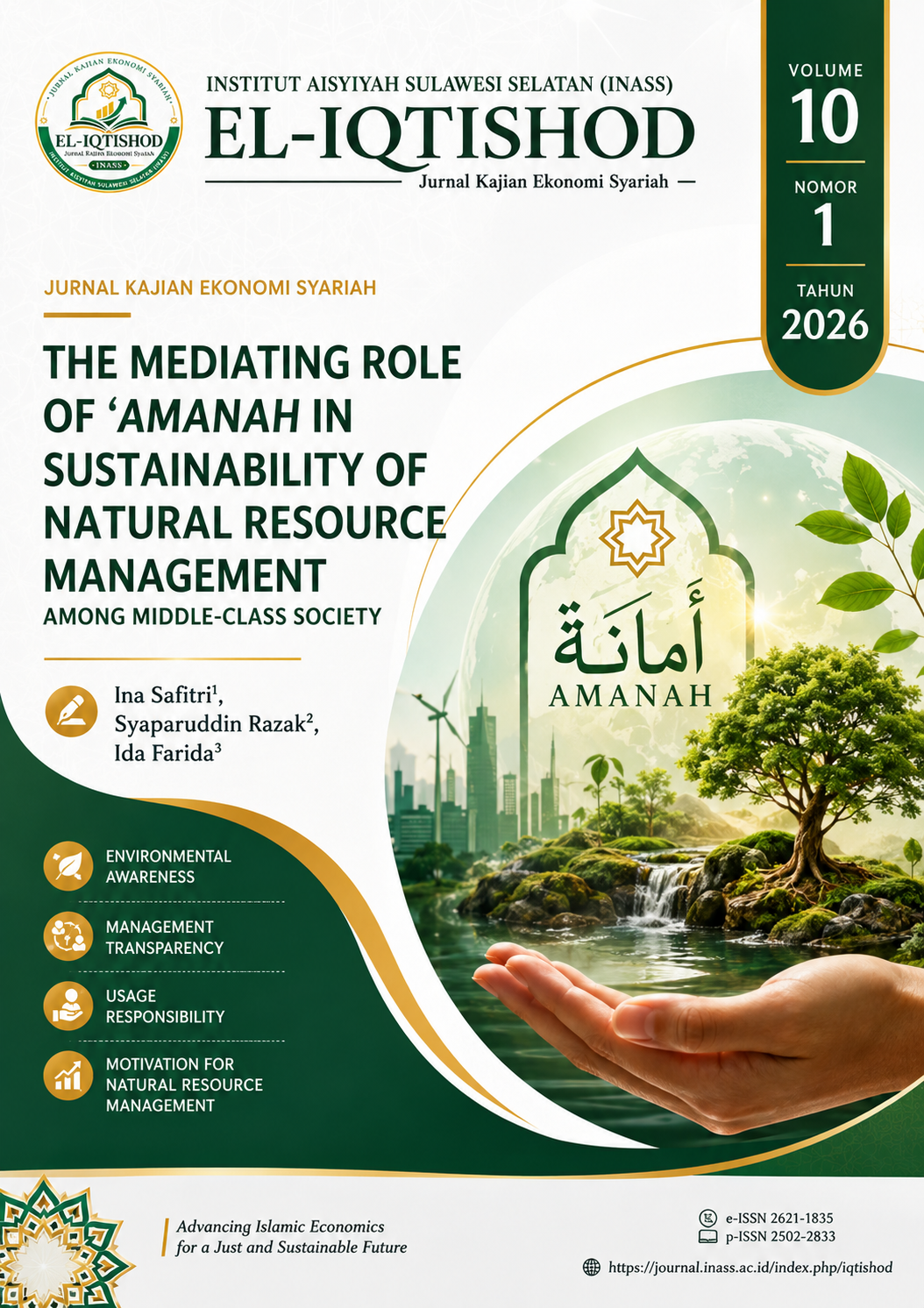
The Mediating Role of Amanah in Sustainability of Natural Resource Management among in Middle-Class Society
Kata Kunci:
Amanah, Natural Resource Management, Sustainability, Environmental Well-BeingAbstrak
This study examines the role of ‘A<ma<nah in promoting fair and sustainable natural resource management among middle-class communities in Bone Regency. The study is motivated by the limited body of research examining the importance of moral and ethical values, particularly ‘A<ma<nah, in fostering environmental sustainability.. It aims to analyze the influence of ‘A<ma<nah on Motivation for Natural Resource Management and its mediating role in the relationship between Environmental Awareness, Management Transparency, and Usage Responsibility toward Motivation for Natural Resource Management. This study employed a quantitative approach using questionnaires distributed to 150 middle-class respondents selected through stratified random sampling across five districts in Bone Regency. Data were analyzed using Structural Equation Modeling (SEM) with SmartPLS. The findings reveal that ‘A<ma<nah significantly influences Motivation for Natural Resource Management. Furthermore, Environmental Awareness, Management Transparency, and Usage Responsibility significantly affect ‘A<ma<nah, which subsequently mediates their relationship with Motivation for Natural Resource Management.These findings suggest that the internalization of ‘A<ma<nah values can strengthen fair, transparent, and sustainable natural resource governance while contributing to the growing body of knowledge on the role of moral values in natural resource management.
Referensi
Ahmad, N. B. (2020). Faith-based approaches to ecological harmony and environmental protection. Rutgers Race & Law Review, 21, 1.
Alam, M. M., & Zakaria, A. F. M. (2021). A probit estimation of urban bases of environmental awareness: Evidence from Sylhet City, Bangladesh. arXiv Preprint, arXiv:2107.08342.
Asgar, Razak, S., & Darwis, R. H. (2022). Adopsi ekonomi sirkular: Peran mediasi sikap dalam model TPB (Theory of Planned Behavior), 30(3).
Avrami, E. (2020). Sustainability, intergenerational equity, and pluralism: Can heritage conservation create alternative futures? In Cultural heritage and the future (pp. 198–216). Routledge.
Azzahra, S., & Maysithoh, S. (2024). Peran Muslim dalam pelestarian lingkungan: Ajaran dan praktik. At-Thullab: Jurnal Mahasiswa Studi Islam, 6(1), 1568–1579.
Bulutoding, L. (2024). Integrasi konsep amanah dalam Shariah Enterprise Theory: Tinjauan literatur komprehensif. Jurnal Ekonomi Syariah Pelita Bangsa, 9(1), 140–148.
Eaton, W. M., Brasier, K. J., Burbach, M. E., Whitmer, W., Engle, E. W., Burnham, M., Quimby, B., Chaudhary, A. K., Whitley, H., & Delozier, J. (2021). A conceptual framework for social, behavioral, and environmental change through stakeholder engagement in water resource management. Society & Natural Resources, 34(8), 1111–1132.
Emina, K. A. (2023). Respecting nature: A study of environmental ethics. International Journal of Environmental Pollution and Environmental Modelling, 6(2), 70–79.
Febriani, R. (2021). Implementation of Islamic value on leadership, organizational culture, and spirituality to performance. Manajemen Bisnis, 11(1), 54–62. https://doi.org/10.22219/mb.v11i1.17006
Gill, A. A., Ahmad, B., & Kazmi, S. (2021). The effect of green human resource management on environmental performance: The mediating role of employee eco-friendly behavior. Management Science Letters 11(6), 1725–1736.
Gottems, L. B. D., Carvalho, E. M. P. D., Guilhem, D., & Pires, M. R. G. M. (2018). Good practices in normal childbirth: Reliability analysis of an instrument by Cronbach’s alpha. Revista Latino-Americana de Enfermagem, 26, e3000.
Hair, J. F., Ringle, C. M., & Sarstedt, M. (2011). PLS-SEM: Indeed a silver bullet. Journal of Marketing Theory and Practice, 19(2), 139–152.
Hair, J. F., Legate, A. E., & Ringle, C. M. (2014). PLS-SEM: A method demonstration in the R statistical environment. Human Resource Development Quarterly, 35(4), 501–529.
He, J., Mao, Y., Morrison, A. M., & Coca-Stefaniak, J. A. (2021). On being warm and friendly: The effect of socially responsible human resource management on employee fears of the threats of COVID-19. International Journal of Contemporary Hospitality Management, 33(1), 346–366.
Heriyanto, & Taufiq. (2024). Nilai-nilai ekonomi dan etika bisnis dalam perspektif Islam. JIMMI: Jurnal Ilmiah Mahasiswa Multidisiplin, 1(1), 24–37.
Hourdequin, M. (2024). Environmental ethics: From theory to practice. Bloomsbury Publishing.
Intan Veronica, D., Fasa, M. I., & Suharto. (2022). Pemanfaatan sumber daya alam terhadap pembangunan berkelanjutan dalam perspektif ekonomi Islam. Jurnal Dinamika Ekonomi Syariah, 9(2), 200–210. https://doi.org/10.53429/jdes.v9i2.391
Koswara, S. A., & Al Mighwar, M. (2023). Application of amanah value to payment products at Bank Syariah Indonesia KCP Bandung Moh. Toha. Al-Fadilah: Islamic Economics Journal, 1(1), 9–16.
Kyriazos, T. A. (2018). Applied psychometrics: The application of CFA to multitrait-multimethod matrices (CFA-MTMM). Psychology, 9(12), 2625–2648.
Mason, M. (2020). Transparency, accountability, and empowerment in sustainability governance: A conceptual review. Journal of Environmental Policy & Planning, 22(1), 98–111.
Maumoh, I., & Yindi, E. H. (2021). Understanding farmers’ environmental citizenship behaviors towards climate change: The moderating and mediating role of environmental knowledge and ascribed responsibility. arXiv Preprint, arXiv:2102.12378.
McLeod, L. J., Kitson, J. C., Dorner, Z., Tassell-Matamua, N. A., Stahlmann-Brown, P., Milfont, T. L., & Hine, D. W. (2024). Environmental stewardship: A systematic scoping review. PLOS ONE, 19(5), e0284255.
Rumbayan, M., Rumbayan, R., Pasiowan, C., & Manahampi, F. (2022). Perancangan pembangkit listrik tenaga mikrohidro: Studi kasus Sungai Tulaun di Desa Lalumpe, Minahasa. Ahlimedia Book.
Mongo, M., Belaïd, F., & Ramdani, B. (2021). The effects of environmental innovations on CO2 emissions: Empirical evidence from Europe. Environmental Science & Policy, 118, 1–9.
Ogbeibu, S., Pereira, V., Burgess, J., Gaskin, J., Emelifeonwu, J., Tarba, S. Y., & Arslan, A. (2021). Responsible innovation in organisations: Unpacking the effects of leader trustworthiness and organizational culture on employee creativity. Asia Pacific Journal of Management, 1–31. https://doi.org/10.1007/s10490-021-09784-8
Orach, K., Duit, A., & Schlüter, M. (2020). Sustainable natural resource governance under interest group competition in policy-making. Nature Human Behaviour, 4(9), 898–909. https://doi.org/10.1038/s41562-020-0885-y
Patwary, A. K. (2023). Examining environmentally responsible behaviour, environmental beliefs, and conservation commitment of tourists: A path towards responsible consumption and production in tourism. Environmental Science and Pollution Research, 30(3), 5815–5824.
Prastiasa, F. R., Bahmiati, S., Putri, A. D., Nasiruddin, F. H., & Amir, D. R. (2024). Dominasi kepentingan politik sempit dan krisis kepercayaan masyarakat terhadap lembaga perwakilan. Prosiding Seminar Nasional Pendidikan FPMIPA, 2(1), 563–571.
Prastiyo, A., Nuraeni, S., Rajab, M., Tumanan, T., Tullah, I. K., Latif, N., Armidha, N., Marshabilla, M., Salsabillah, K., & Rusli, A. M. (2022). Pemberdayaan masyarakat sekitar Hutan Pendidikan Universitas Hasanuddin Desa Rompegading Kabupaten Maros melalui pengembangan meliponikultur. Mitra Mahajana: Jurnal Pengabdian Masyarakat, 3(1), 41–49.
Purnawansyah, P., Hayati, L. N., Supriyadi, M. I., Anugrah, R., & Hamzah, M. N. (2021). Optimasi web sumber daya lokal untuk pengembangan potensi desa pada Lembang Marinding, Desa Kandora, Kecamatan Mangkendek, Kabupaten Tana Toraja. Ilmu Komputer untuk Masyarakat, 2(2).
Rashed, A. H., & Shah, A. (2021). The role of the private sector in the implementation of sustainable development goals. Environment, Development and Sustainability, 23(3), 2931–2948.
Schermelleh-Engel, K., Kerwer, M., & Klein, A. G. (2014). Evaluation of model fit in nonlinear multilevel structural equation modeling. Frontiers in Psychology, 5, 181.
Sidiq, R. S. S., Jalil, A., & Achmad, R. W. W. (2021). Virtual world solidarity: How social solidarity is built on the crowdfunding platform Kitabisa.com. Webology, 18(1). https://doi.org/10.14704/WEB/V18I1/WEB18083
Umiyati, Habibullah, & Rini. (2023). Peran audit syariah dalam meningkatkan akuntabilitas pada organisasi pengelola zakat. Jurnal Bimas Islam, 16(2), 313–342.
Van der Bles, A. M., Van der Linden, S., Freeman, A. L. J., & Spiegelhalter, D. J. (2020). The effects of communicating uncertainty on public trust in facts and numbers. Proceedings of the National Academy of Sciences, 117(14), 7672–7683. https://doi.org/10.1073/pnas.1913678117
Vergura, D. T., Zerbini, C., Luceri, B., & Palladino, R. (2023). Investigating sustainable consumption behaviors: A bibliometric analysis. British Food Journal, 125(13), 253–276.
Wattimena, L., Serkadifat, Y. S., Rante, F., et al. (2023). Upaya menumbuhkan kesadaran menjaga kelestarian lingkungan pada anak-anak Panti Asuhan Cipta Waris Papua. AMMA: Jurnal Pengabdian Masyarakat, 2(6), 714–719.
Zheng, Y., Epitropaki, O., Graham, L., & Caveney, N. (2022). Ethical leadership and ethical voice: The mediating mechanisms of value internalization and integrity identity. Journal of Management, 48(4), 973–1002.
Unduhan
Diterbitkan
Cara Mengutip
Terbitan
Bagian
Lisensi
Hak Cipta (c) 2026 Ina Safitri, Syaparuddin Razak, Ida Farida

Artikel ini berlisensi Creative Commons Attribution 4.0 International License.